Yoga Nidra — Guided Deep Rest
A guided practice that invites the body to become still while awareness follows a structured journey through sensation, sound, body awareness, natural breathing, inner observation and a gradual return.
What Yoga Nidra Is
In the source tradition, Yoga Nidra is presented as a Pratyahara or inward-turning practice. A facilitator guides the participant through a systematic sequence while the body rests. At Insda Wellness Resort, it is presented as guided deep rest and awareness rather than as medical treatment.
Awareness and Sleep
Participants are invited to remain aware of the facilitator's voice, although drifting into sleep may occur. The practice should be approached without self-judgment. Falling asleep is not treated as failure, and the programme does not promise or guarantee sleep.
The Practice Journey
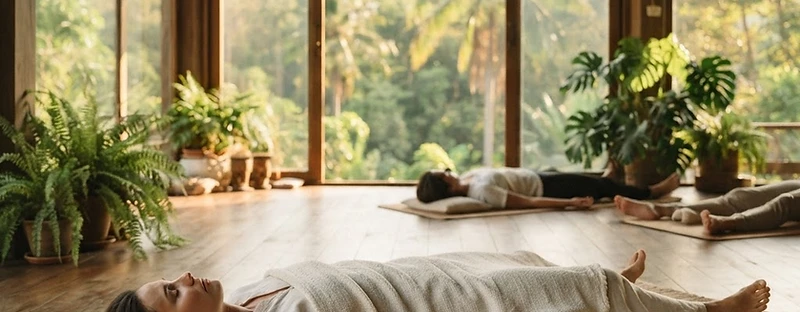
Settle into the space, choose a supported restorative position, reduce unnecessary movement and prepare to follow the facilitator's voice.
Shavasana is the principal posture in the source material, while other comfortable positions may be used when lying on the back is unsuitable. Comfort and safety take priority.
Selected sessions begin with gentle tensing and releasing of different parts of the body, followed by a sense of letting go.
Awareness moves from distant sounds to nearby sounds, the body and the inner field of experience, without analysing what is heard.
The facilitator guides awareness systematically through major and individual parts of the body. The practice is a pathway of attention rather than an attempt to change the body.
Some variants introduce simple paired experiences such as heaviness and lightness or warmth and coolness. More emotionally provocative practices are not part of the public self-practice instructions.
Attention rests with the spontaneous rhythm of breathing. Depending on the session, awareness may move through the navel, chest, throat and nostrils, with optional backward counting.
With the eyes closed, participants are invited to observe the inner field of experience with patience and without becoming involved in what appears.
The Relaxing the Mind variant may use rapid images or a simple storyline. The public page explains the approach without publishing the complete facilitator script.
Sankalpa appears in the broader training material as a later-stage component. It is introduced only in appropriate programme variants and is not automatically added to beginner sessions.
The practice closes by returning awareness to the breath, body, sounds and surroundings. Participants reorient gently and rise slowly only when fully awake.
After the session, participants may quietly notice how they feel and share only what they choose. Personal reflection is optional and must not be forced.
Programme Variants
Relaxing the Body
A foundational guided session emphasising settling, gentle tense-and-release, sound awareness, rotation of awareness, natural breath awareness, Chidakash and a gradual return.
Relaxing the Mind
A progressive session that adds awareness of simple opposites and guided visualisation to the foundational Yoga Nidra sequence.
Breath Awareness Yoga Nidra
A session centred on the spontaneous breath and optional backward counting at selected body areas.
Ajapa Japa Yoga Nidra
A Yoga Nidra variant associated with the existing Ajapa Japa source collection. The descriptive programme entry may be shown publicly; audio should appear only when a usable approved media asset is connected.
Evening Yoga Nidra
A gentle evening deep-rest format using foundational Yoga Nidra components and a careful gradual return.
Corporate Deep Rest
An inclusive non-liturgical format for organisations using body settling, sound awareness, rotation of awareness, natural breath and gradual return.
Private Yoga Nidra
A private session configured around preferred language, restorative position, duration, experience level and appropriate practice components.
Yoga Nidra for Retreats
Yoga Nidra configured as part of a residential or non-residential retreat itinerary.
Preparation
- Wear comfortable clothing and arrive early.
- Avoid a heavy meal immediately before the session.
- Tell the facilitator about mobility or comfort needs.
- Use blankets, bolsters or other approved supports.
- You may move, open the eyes, pause or leave when needed.
Safety and Wellbeing
Yoga Nidra at Insda Wellness Resort is a guided wellbeing practice, not medical diagnosis or treatment. Individual experiences vary. Participate within your comfort, stop when you feel unwell, and seek appropriate professional advice for health concerns.
Shanti Mantras — Optional Traditional Content
This section is optional traditional content. Thai and Chinese are explanatory meanings for accessibility, not canonical Sanskrit translations. Chanting is never required to participate in Yoga Nidra.
Opening Shanti Mantra
Om Saha Naavavatu
Saha Nau Bhunaktu
Saha Viryaam Karavaavahai
Tejasvi Naavadhitamastu
Maa Vidvishaavahai
Om Shaantih Shaantih Shaantih
May teacher and student be protected and supported together. May we work with full energy, may our study be fruitful, and may there be no ill-will between us. May peace and harmony prevail.
ขอให้ครูและศิษย์ได้รับการคุ้มครองและเกื้อหนุนร่วมกัน ขอให้เราศึกษาและปฏิบัติด้วยพลังอย่างเต็มที่ ให้การเรียนรู้เกิดผลดี และไม่เกิดความขัดแย้งหรือความไม่ปรารถนาดีต่อกัน ขอให้ความสงบและความกลมกลืนดำรงอยู่
愿老师与学习者共同受到守护与支持,愿我们以充沛的力量学习与实践,愿学习有所成就,彼此不生敌意。愿和平与和谐常在。
Closing Shanti Path
Asato ma sad gamaya
Tamaso ma jyotir gamaya
Mrityor ma amritam gamaya

Sarvesham swastir bhavatu
Sarvesham shantir bhavatu
Sarvesham poornam bhavatu
Sarvesham mangalam bhavatu
Loka samasta sukhino bhavantu
Lead me from untruth or ignorance toward truth, from darkness toward light, and from mortality toward that which is beyond death. May all beings know wellbeing, peace, wholeness and auspiciousness. May beings everywhere be happy.
ขอให้นำเราจากความไม่รู้ไปสู่ความจริง จากความมืดไปสู่แสงสว่าง และจากความยึดติดในความตายไปสู่ความเข้าใจที่พ้นจากความกลัวต่อความตาย ขอให้สรรพชีวิตมีความเป็นสิริมงคล มีสันติ มีความสมบูรณ์ และมีความสุข
愿我们从无明走向真实,从黑暗走向光明,从对死亡的局限走向更深的理解。愿一切众生安好、和平、圆满、吉祥;愿世界各处的众生获得幸福。
Mahamrityunjaya Passage
Om trayem bakum yaja mahe
Sugandhim pushti vardenam
Uruva rukamiva bandhanat
Mrityor mukshiyamamritat
The source explains this as an invocation connected with release from attachment and with moving through mortality with greater freedom.
ต้นฉบับอธิบายบทนี้ในความหมายของการคลายความยึดติด และการก้าวผ่านความไม่เที่ยงและความตายด้วยอิสรภาพภายในที่มากขึ้น
原始资料将此段解释为对放下执着的祈愿,以及以更大的内在自由面对无常与死亡。
End-of-Course Shanti Mantra
Om purnamadah purnamidam
Purnat purnamudachyate
Purnasya purnamadaya
Purnameva vashishyate
Om Shantih Shantih Shantih
That is whole; this is whole. From wholeness, wholeness arises. Even when wholeness is taken from wholeness, wholeness remains. May peace prevail.
สิ่งนั้นสมบูรณ์ สิ่งนี้สมบูรณ์ จากความสมบูรณ์ย่อมเกิดความสมบูรณ์ แม้นำความสมบูรณ์ออกจากความสมบูรณ์ ความสมบูรณ์ก็ยังคงอยู่ ขอให้สันติจงดำรงอยู่
彼为圆满,此亦圆满;圆满由圆满而生。即使从圆满中取出圆满,圆满仍然存在。愿和平常在。
Join a Guided Session
Current price is available on request. The final quotation depends on travel dates, room type, number of participants, programme configuration, meals, treatments, transport, and selected activities.